Markets · 3 min read
Markets. Psychology. Data.
Financial markets are never just numbers on a screen — they are the sum of human behavior, capital flows, and collective psychology. In the Indian equity markets, this interplay becomes most visible when we look at the relationship between the Nifty 50 index and the flows from Foreign Institutional Investors (FII) and Domestic Institutional Investors (DII/Mutual Funds).
Let's analyze what the data tells us.
1. The long-term Nifty journey
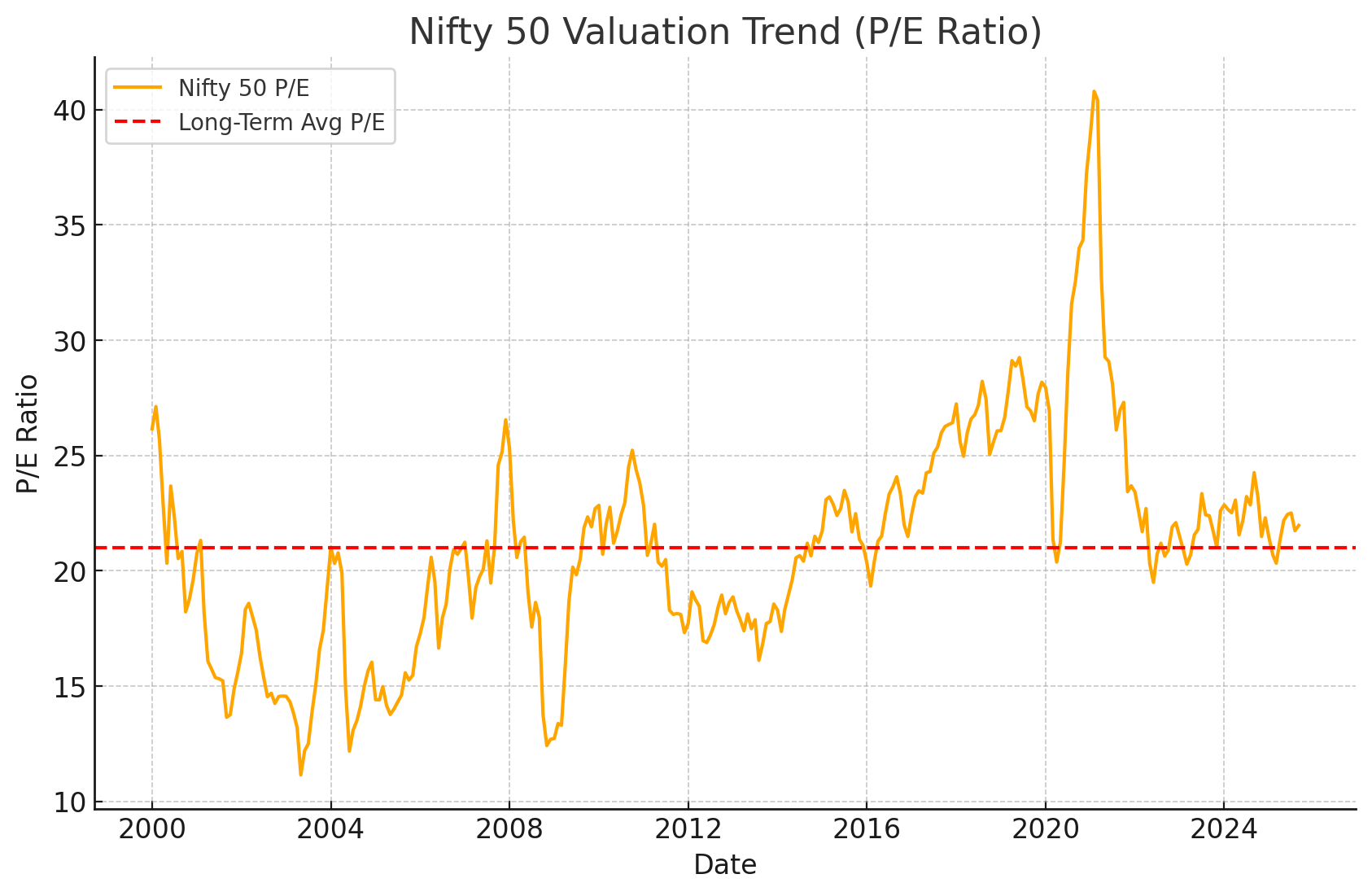
From the year 2000 to today, the Nifty 50 has climbed from 1,546 to 25,114. That's a 16x growth in 25 years — a reminder that despite volatility, equity markets have rewarded patient investors.
- Average P/E ratio: ~21
- High valuations: the peak valuation (P/E 40.8 in 2008) coincided with euphoria before the global financial crisis.
- Low valuations: P/E bottoms around 11–12 (e.g., 2003) were often followed by multi-year bull runs.
This pattern is a psychological cycle: when valuations are low, fear dominates; when valuations are high, greed takes over.
2. FII vs DII: the capital tug-of-war
The last 12 months highlight the contrasting behavior of global vs. domestic investors:
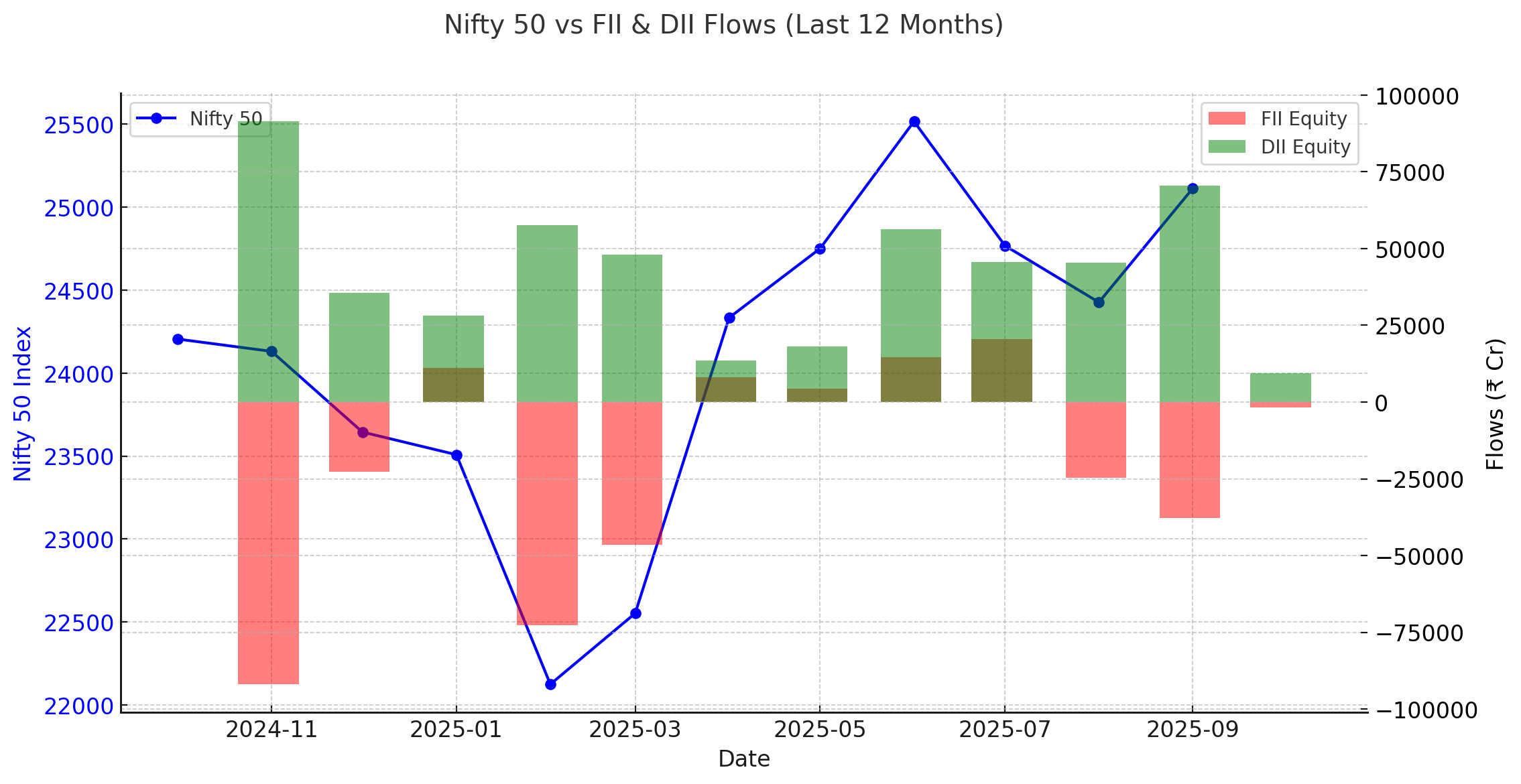
- October 2024: FIIs pulled out a record ₹91,933 cr, while DIIs stepped in with ₹91,433 cr.
- Jan–Feb 2025: FIIs again sold heavily (₹72,675 cr in Jan, ₹46,600 cr in Feb), cushioned by strong domestic inflows.
- Jul–Aug 2025: FIIs sold (₹24,723 cr, ₹37,823 cr), but mutual funds absorbed the supply, investing ₹45,399 cr and ₹70,534 cr respectively.
- Sep 2025: both sides slowed down — FIIs sold mildly (₹1,799 cr), DIIs invested just ₹9,308 cr.
This data underscores a recurring theme: when FIIs sell, DIIs buy. Domestic liquidity, powered by rising SIP flows, has become the stabilizer of Indian markets.
3. Market performance vs flows
Interestingly, despite record FII outflows, the Nifty has remained resilient:
- Oct 2024 to Sep 2025: Nifty moved from 24,205 to 25,114, a modest gain of ~4%.
- During months of sharp FII selling (e.g., Jan–Feb 2025), the index corrected (from 23,508 to 22,124), but domestic buying limited the damage.
- By mid-2025, the Nifty regained momentum, touching an all-time high of 25,517 in June 2025.
This resilience shows the psychology of flows: global investors are often driven by macro risks (US yields, Fed policy, oil prices), while domestic investors focus on India's structural growth story.
4. What this means for investors
- Valuations matter: current P/E (~22) is close to the long-term average. Not cheap, not euphoric.
- Domestic flows are the buffer: even when FIIs panic, SIP-driven inflows provide stability — a major shift from the 2000s when markets crashed with FII exits.
- The psychology angle: FIIs act as "fast money," highly sensitive to global risk. DIIs act as "patient capital," reflecting rising investor confidence within India.
For investors, the lesson is clear:
- Don't get swayed by FII headlines alone.
- Use corrections (often triggered by FII selling) as opportunities.
- Anchor decisions in data and valuations, not noise.
Closing thought
Markets are a mirror of collective psychology — fear and greed. The Nifty's long-term journey, cushioned by the growing power of domestic money, shows that data-backed patience often outperforms emotion-driven panic.
In the tug-of-war between FIIs and DIIs, the real winner is the investor who sees the bigger picture.
Educational content, not investment advice.