Strategies · 4 min read
Introduction
When interest rates rise or fall, debt fund returns don't all move in the same direction. Some respond instantly, others lag — or even move opposite to the bond yield trend.
We analyzed 10 years of data (2015–2024) covering Indian 10-Year and 3-Month Government Bond Yields alongside returns of major debt fund categories. The findings show clear, data-backed patterns that help investors — both new and experienced — align their debt portfolios with changing rate environments.
This post explains those patterns, illustrates them with charts, and provides actionable strategies on how to position across Ultra-Short, Short-Term, Dynamic Bond, and Gilt Funds based on the rate cycle.
1. Market perspective — what the data shows
Over the past decade, bond yields in India have oscillated between the extremes of 5.8% and 8.2% on the 10-year benchmark, reflecting cycles of liquidity expansion, inflation scares, and central bank interventions.
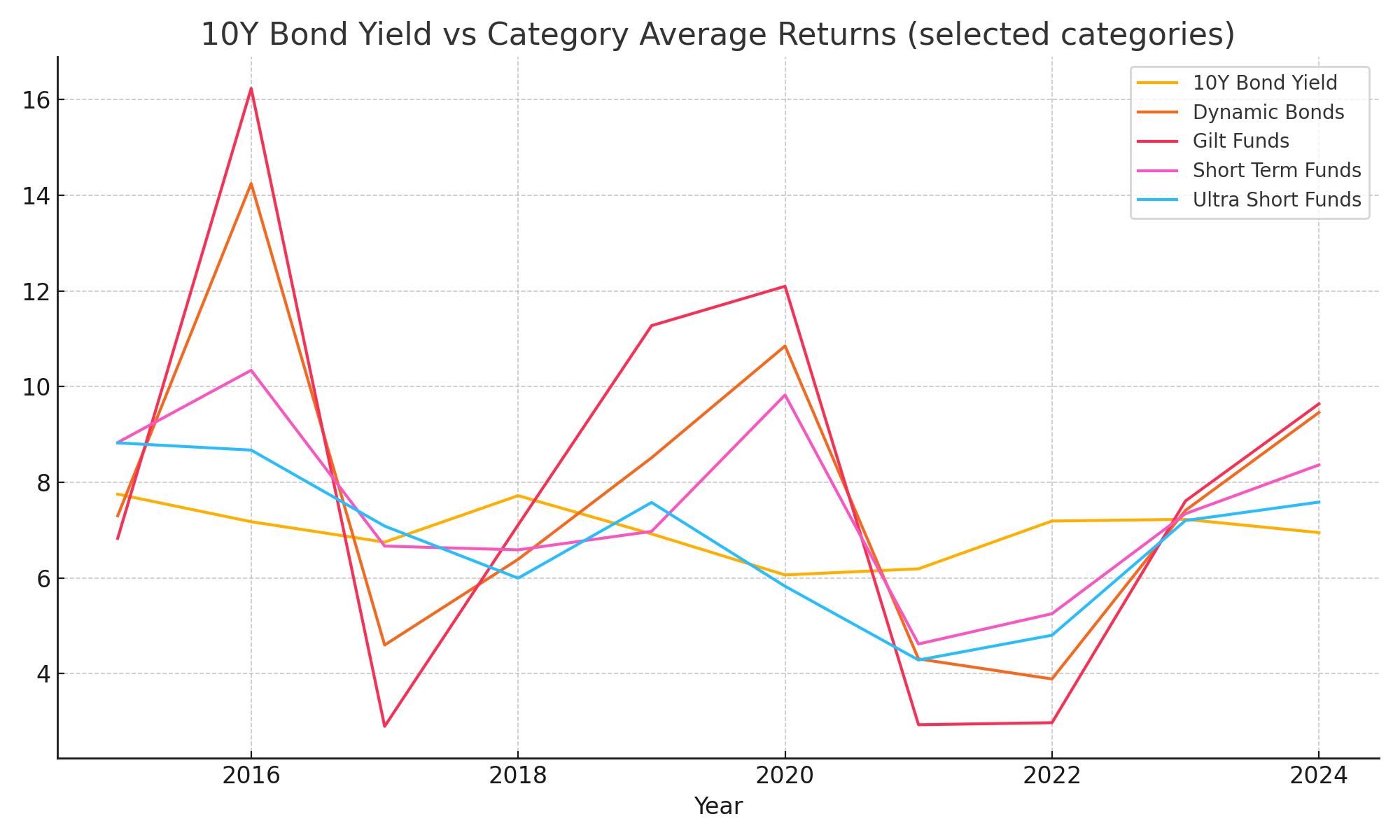
To understand how these yield swings influence mutual fund performance, we computed average annual bond yields (10-Year and 3-Month) alongside average category returns across debt fund types.
Observation:
- Ultra-short and short-term funds show smoother, lower volatility returns.
- Gilt and dynamic bond funds fluctuate sharply, sometimes outperforming or underperforming in sync with yield reversals.
This pattern is rooted in duration sensitivity — the longer the maturity of underlying bonds, the higher the impact of yield changes on fund NAVs.
2. Investor psychology — the hidden traps in debt investing
Debt investors often assume these funds are "safe" and steady. But psychology plays a powerful role in outcomes:
- Recency bias: chasing high gilt fund returns right after yields have fallen — missing the rally's best part.
- Anchoring: assuming last year's 7% short-term fund return will continue, even as short-term yields fall.
- Loss aversion: exiting dynamic bond funds after a temporary mark-to-market fall — right before the recovery.
Understanding the yield-return relationship helps investors stay rational when market noise tempts emotional reactions.
3. Data insights — bond yields vs debt fund categories
Let's look at the quantitative relationships found in our analysis:
| Category | Correlation with 10-Year Yield | Correlation with 3-Month Yield |
|---|---|---|
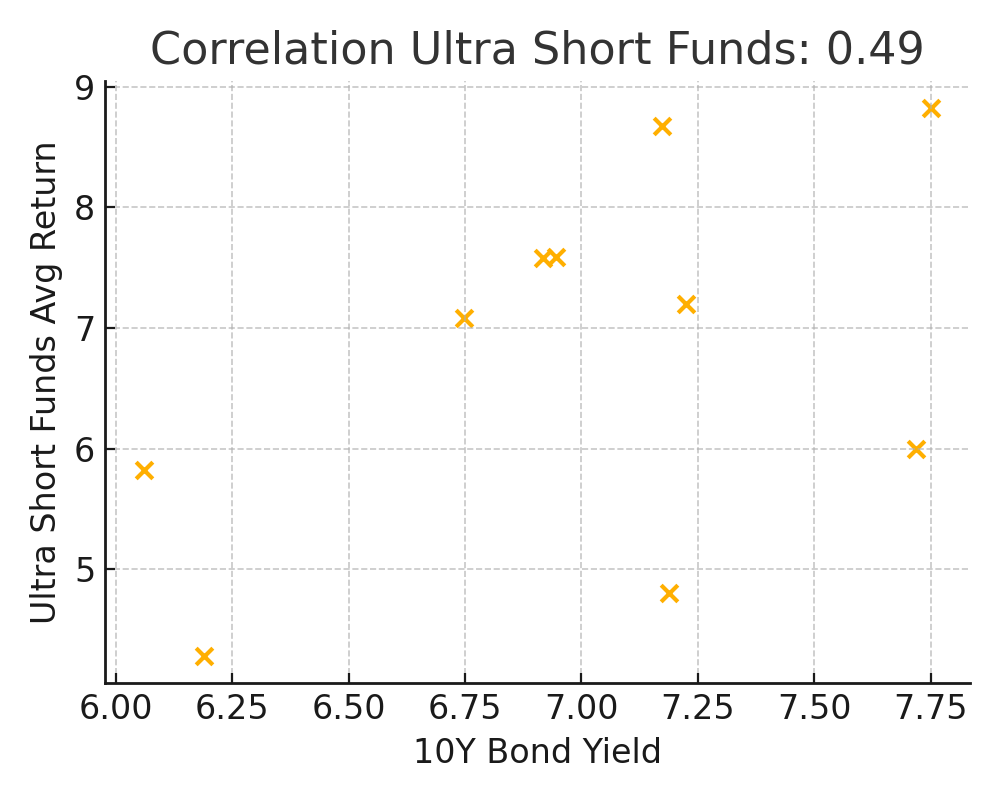
| Ultra Short Funds | +0.49 | +0.80 |
| Short Term Funds | +0.23 | +0.52 |
| Dynamic Bonds | +0.07 | +0.18 |
| Gilt Funds | +0.10 | +0.15 |
(Values derived from annual data 2015–2024)
Interpretation:
- Ultra Short Funds track short-term yield changes most closely (correlation 0.80 with 3M yield). They adjust fast as RBI policy rates change.
- Short Term Funds respond moderately to both ends of the curve.
- Dynamic Bonds and Gilt Funds show weak correlation — returns are driven more by active duration management and market timing than static yield levels.
Visual insight: correlation scatters
Below is one of the scatter plots illustrating how Ultra-Short Funds move nearly in line with the short-term yield:
4. Implications for investors — turning data into strategy
Let's translate these numbers into investment actions:
A. Rising rate environment
When RBI is tightening and short-term yields rise:
- Increase exposure to Ultra-Short or Liquid Funds — they benefit fastest from new high-yield instruments.
- Reduce long-duration exposure in Gilt or Dynamic Funds which face mark-to-market losses.
B. Falling rate environment
When inflation cools and yields decline:
- Add allocation to Gilt Funds or Long Duration Funds — they gain capital appreciation as bond prices rise.
- Maintain Short-Term Funds as stable income sources during the transition.
C. Volatile or uncertain environment
When direction of rates is unclear:
- Dynamic Bond Funds shine — managers adjust duration actively.
- Build a duration ladder (Ultra-Short + Short-Term + Dynamic) to smooth risk and return.
Professional tip: Dynamic funds can outperform static-duration funds if the manager correctly anticipates yield curve moves. But the weak correlations suggest manager skill, not just rate level, drives returns — making fund selection critical.
5. For experienced investors — tactical positioning
For active allocators:
- Track the yield curve spread (10-Year minus 3-Month). A narrowing spread favours short-term and dynamic funds; a widening spread favours a tilt towards gilts or duration plays.
- Combine credit spreads with yield data to identify risk-reward asymmetry.
- Use target maturity funds to lock in yields when rates appear near cyclical peaks.
This approach aligns macro expectations with portfolio duration exposure, creating alpha without unnecessary credit risk.
6. Closing thoughts — balancing yield and behavior
Debt investing isn't just about chasing yield — it's about balancing return expectations with interest rate cycles and investor psychology.
Over the past decade, ultra-short funds rewarded patience during rate hikes, while gilt and dynamic funds rewarded conviction during easing cycles. The key is to align duration with your time horizon and avoid reacting emotionally to short-term volatility.
When rates rise, shorten your duration.
When rates fall, lengthen it.
When uncertain, diversify duration.
When rates fall, lengthen it.
When uncertain, diversify duration.
The data confirms it. The markets prove it. Investor discipline sustains it.
Educational content, not investment advice.